Friday, September 18, 2026
INJECTOSE : FragOse - An injection-moulded fragrance cap made from 95% cellulose fibres
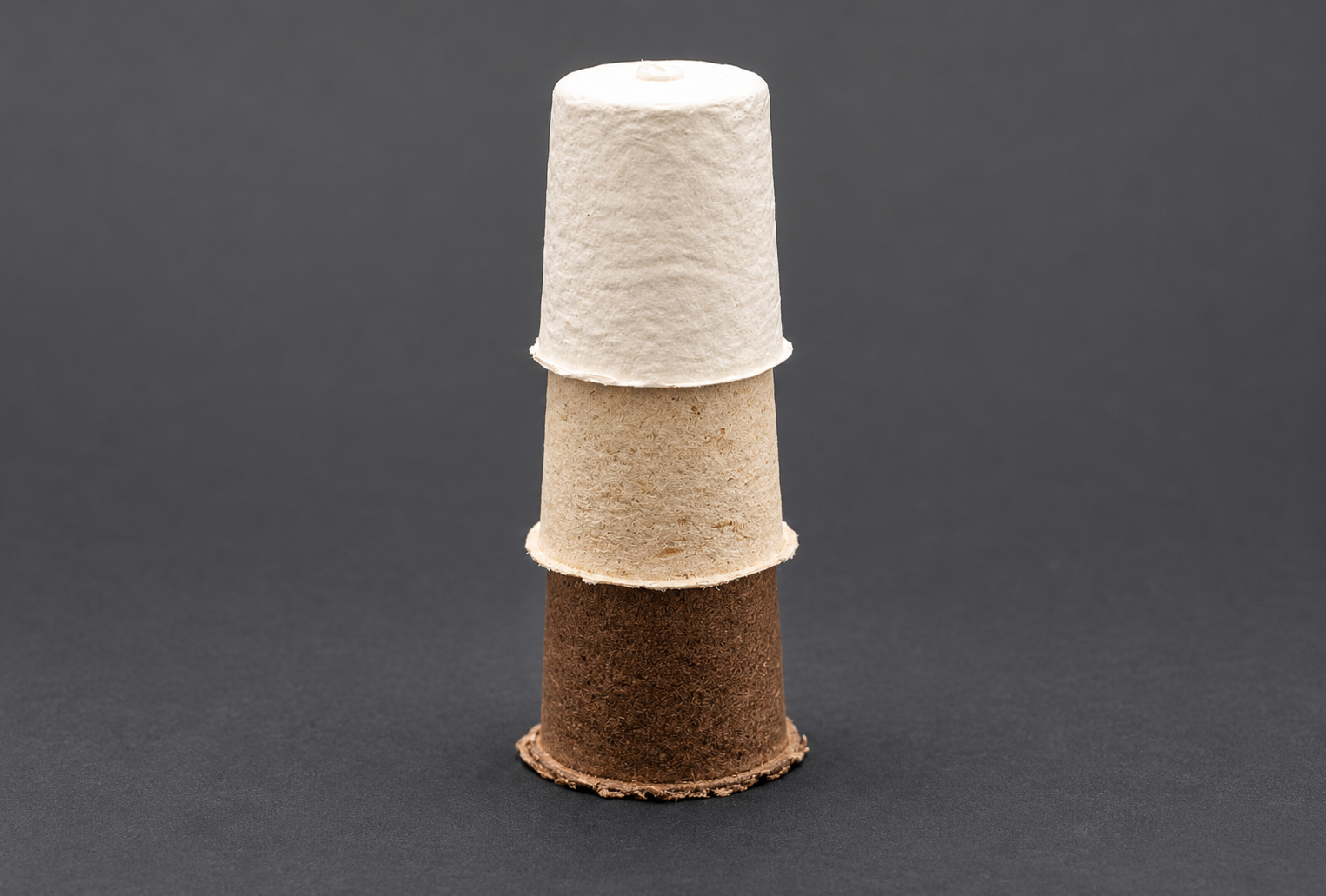
Injectose brings the possibilities of plastic injection moulding to a cap made predominantly from cellulose fibres.
With ReCap, Injectose is developing an injection-moulded fragrance cap made from 95% cellulose fibres. Still at the prototype stage, the solution aims to deliver the precision and complex shapes enabled by injection moulding while remaining recyclable through the paper recycling stream.
Injectose presents ReCap as the world’s first injection-moulded cap of its kind to contain such a high proportion of cellulose fibres.
A material made from 95% cellulose fibres
ReCap is based on a mono-material architecture composed of 95% cellulose fibres.
Several formulations have already been developed, using virgin pulp sourced from FSC-certified forests, mass-coloured material, upcycled urban fallen leaves in partnership with Releaf, and green algae fibres developed with design studio Samuel Tomatis.
The technology could also enable the integration of co-products generated during fragrance production.
According to Injectose, the natural additive used in the formulation reduces the amount of fibre required by 30% compared with wet-moulded cellulose and by 50% compared with dry-moulded cellulose.
Bringing injection-moulding precision to cellulose
Injectose’s technology is based on a closed-mould injection process.
This method makes it possible to create smooth or textured surfaces and achieve a level of rigidity that the company says is comparable to polypropylene.
The process also helps prevent certain material losses: every gram introduced into the mould is incorporated into the final part.
Injectose also reports water consumption that is 50 times lower than conventional moulded cellulose, notably because the process eliminates dilute suspension and pressing stages.
Adapting existing injection-moulding machines
One of the technology’s key features is a retrofit kit designed for existing injection-moulding machines.
The same production line could therefore be used to inject plastic and, after adaptation, Injectose’s material, without requiring the installation of a dedicated production line.
Since January 2026, Injectose has been working with the French Technical Centre for Plastics and Composites (IPC) in Oyonnax to develop and validate the reliability of this system.
Collaborations are also underway with several machinery manufacturers and packaging industry players to prepare the technology for industrialisation.
A solution still at the prototype stage
ReCap is currently at the prototype stage, with a present pellet production capacity of around 10 tonnes per year.
Trials are underway with a packaging manufacturer as well as with a consortium of luxury and cosmetics industry players.
Injectose is also planning to install its first production unit in the Grenoble area, close to pulp suppliers and the plastics manufacturing cluster in Oyonnax.
An end of life designed for the paper recycling stream
ReCap has been designed to preserve the integrity of its cellulose fibres so that they can be repulped and reintegrated into existing paper recycling streams.
Injection and drying parameters are adjusted from the manufacturing stage with this objective in mind.
Injectose also reports that an initial study carried out with Kanazawa University in Japan observed material degradation within three weeks.
The corresponding certifications, as well as a full Life Cycle Assessment, are still to come.